Background: The Centers for Medicare & Medicaid Services (CMS) identify social drivers of health (SDoH) as a crucial component of high-value care. Since January 2024, CMS has required screening for five SDoH in all patients aged 18 years or older admitted to the hospital, although this requirement has now been removed for fiscal year 2026. Internal medicine (IM) resident knowledge or behavior related to the screen is unknown.
Methods: We performed a survey-based study of IM and IM-Pediatrics residents at two sites: the Osler Medical Residency at Johns Hopkins Hospital (survey distributed September 2024) and the Bayview Internal Medicine Residency Program at Johns Hopkins Bayview Medical Center (survey distributed October 2024). Residents were invited to participate in a survey assessing their knowledge and attitudes surrounding the required SDoH screening, distributed via REDCap. The survey was anonymous and incentivized with a $5 gift card. Survey responses were analyzed with descriptive statistics and Chi-square analysis by JASP (Amsterdam, Netherlands, Version 0.18.1). The study was acknowledged as exempt by the IRB.
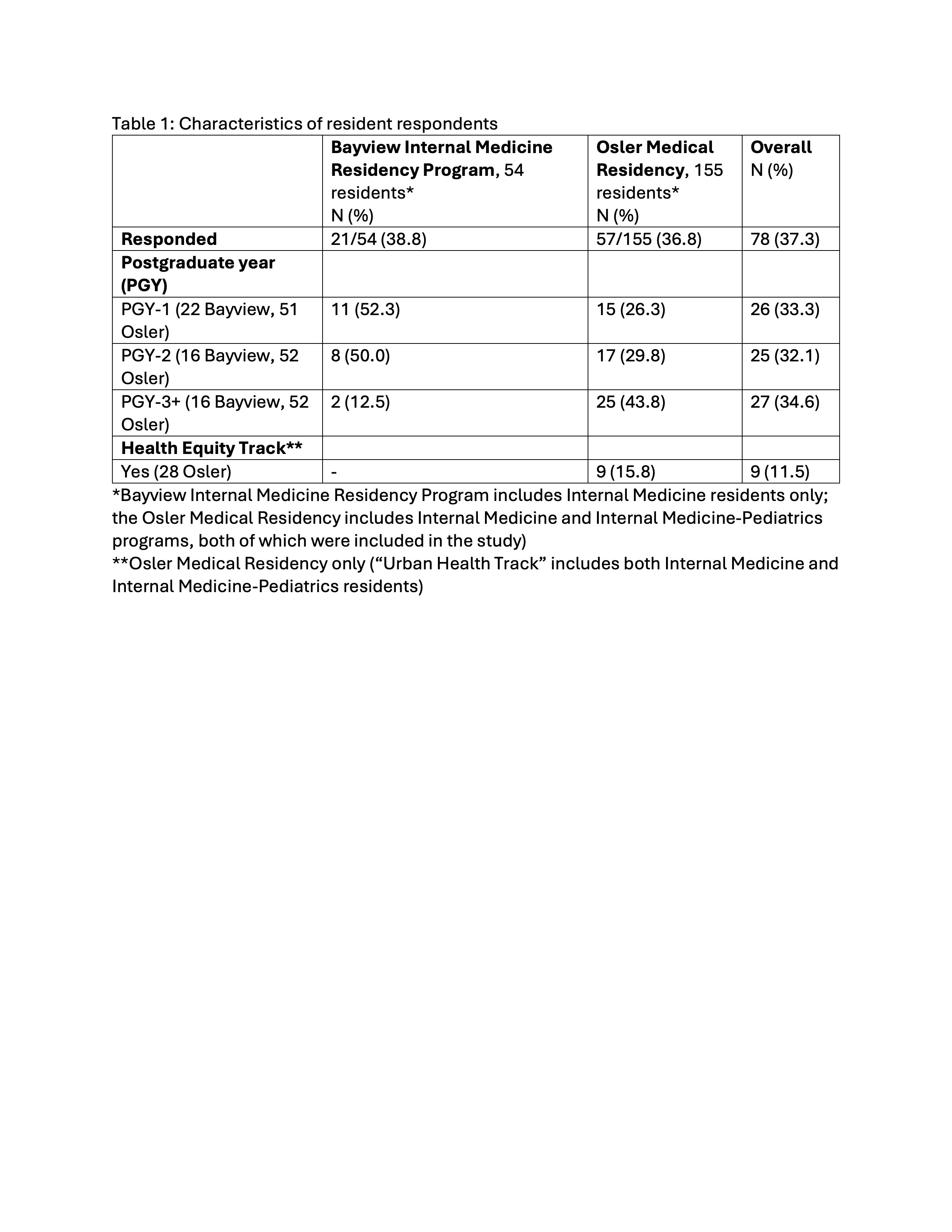
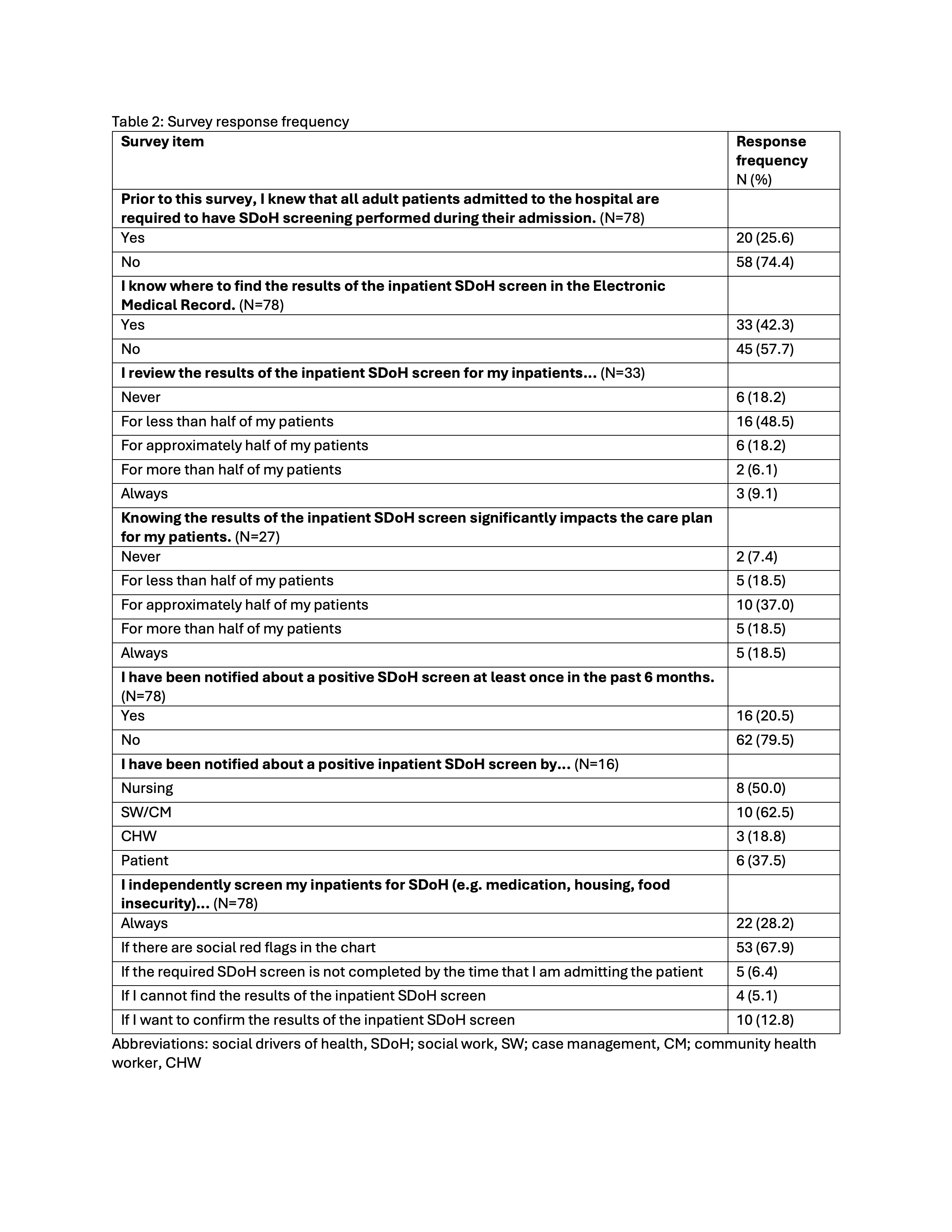
Results: Seventy-eight total residents responded to the survey (37.3%) with similar response rates across programs (Table 1). The majority of respondents did not know that there was a required SDoH screen (74.4%, 58/78) and did not know where to find the results of the screen (57.7%, 45/78), shown in Table 2. Of residents who knew where to find the screen results, only 33.3% (11/33) reviewed the results for half of their patients or more, but 74.1% (20/27) agreed that the results of the screen significantly impacted the care plan for half of their patients or more. Only 20.5% (16/78) of residents had been notified about a positive screen. Residents’ own SDoH screening practices were variable, but most residents reported screening if social red flags were present in the chart (67.9%, 53/78). There were no significant differences in likelihood of screen knowledge across residency programs (Bayview, 38.1% vs. Osler, 21.1%, p=0.126), postgraduate year (PGY) (PGY-1, 19.2% vs. PGY-2, 36.0% vs. PGY-3+ 22.2%, p=0.344), or Health Equity track participation (yes, 22.2% vs. no, 20.8%, p=0.925).
Conclusions: IM resident knowledge of required SDoH screening was low, although residents with knowledge of the screen reported that it often changed their patients’ care plans. Additional research is necessary to identify best practices to incorporate social needs screening data into clinical practice, especially in light of shifting public health policy.