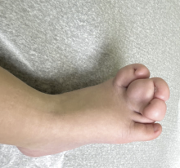
Case Presentation: A 14-month-old male with history of hemihypertrophy of left lower extremity and macrodactyly of the left third to fifth toes, as well as syndactyly of third and fourth toes, presented to the ER because of facial swelling and anasarca. The swelling began 10 days prior to admission, diagnosed initially as bilateral preseptal cellulitis by primary pediatrician and prescribed amoxicillin/clavulanate and ciprofloxacin drops. After no improvement he was brought for further evaluation.Evident anasarca, mainly in arms and lower extremities and facial edema was present.The left lower extremity was known hypertrophied and left toes findings unchanged. No scrotal edema noted. Rest of the exam unremarkable. Vital signs were within normal limits. Labs showed WBC 15.6 10K/uL. Hb 8.9 g/dL, RBC 3.9 M uL ,MCV 74.8 fL, RDW 15.4 and PLT 569 10K/uL. Mentzer index 19.4 and RDW index 292.Iron level and ferritin were low with elevated TIBC.Electrolytes, lipid panel, renal and liver function within normal limits. Albumin 2.0 mg/dLUrine dipstick proved negative protein and urinalysis negative for proteinuria. A CXR was normal.He received a dose of IV albumin followed by furosemide.
Discussion: The initial concern of nephrotic syndrome was ruled out because of absent proteinuria and hyperlipidemia. Upon further questioning, mother disclosed that he usually drinks about 30 oz/day of milk. Differential diagnoses included nephrotic syndrome, protein-losing enteropathy, A1AT deficiency, IBD among other causes of malabsorption. With nephrotic syndrome ruled out, the most likely diagnosis was protein-losing enteropathy in the setting of iron deficiency anemia secondary to excessive cow’s milk intake. This is a well described entity and one of the less recognized consequences of IDA. To confirm the diagnosis, an A1AT level in stool proved significantly elevated.It is hypothesized that iron deficiency impairs the function of epithelial tight junctions in the intestinal lumen predisposing to protein leakage. Other hypotheses single out milk-induced damage to the intestinal epithelium. Excessive cow’s milk ingestion predisposes anemia by avoiding iron-rich foods and impaired iron absorption in the intestine. The parents were explained to reduce milk amount and avoid cow’s milk in favor of a plant-based milk until resolution of the presentation.Additionally, he is being worked up by hematology/oncology, orthopedics and plastic surgery for PROS (PIK3CA Related Overgrowth Syndrome) and is likely to be placed on treatment with alpelisib. PIK3CA is a gene that controls cellular proliferation and apoptosis.
Conclusions: This interesting case was challenging because the most common cause of anasarca in the pediatric population is nephrotic syndrome. Further questioning revealed the diagnosis, and although iron deficiency anemia is common and easily identified and treated, protein-losing enteropathy is a rarer complication and not well-known etiology by many providers. Treatment with iron supplementation usually corrects both pathologies. PROS is an umbrella term to refer to the spectra of asymmetric hypertrophy and malformation syndromes such as CLOVES, Klippel-Trenauney, FAVA, M-CM. Alpelisib was FDA approved in 2022 as treatment for PROS.