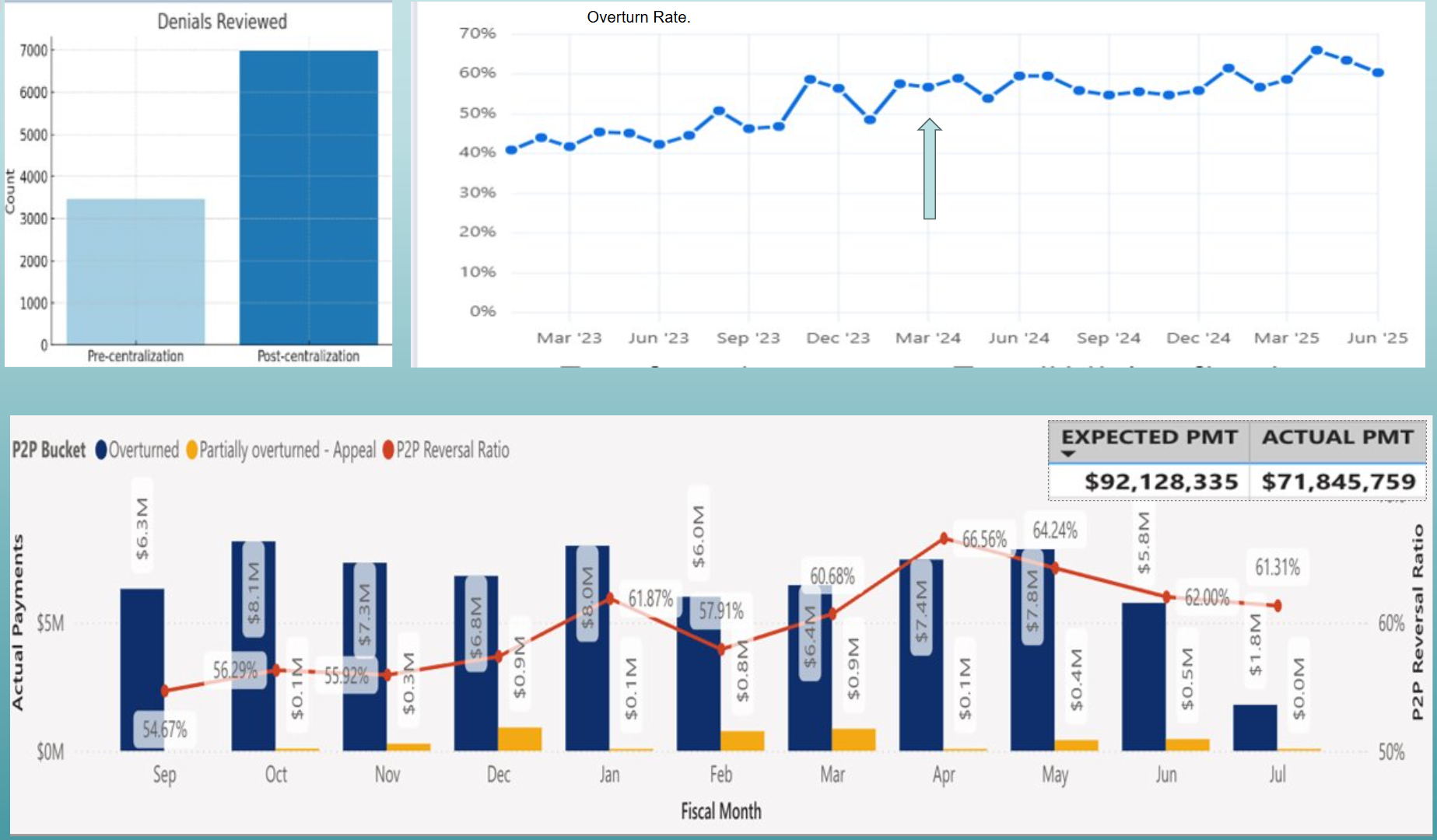
Background: Academic health systems face growing challenges from medical necessity denials and the administrative burden on frontline providers. In 2024, Emory Healthcare implemented a centralized, all-hospitalist Physician Advisor (PA) program to standardize denial management, optimize admission status decisions, and support clinicians across six hospitals.
Purpose: To assess the impact of a centralized PA team on denial prevention and recovery, provider education, and financial outcomes.
Description: Utilization review metrics from FY23–24 (pre-centralization) were compared to FY25 (post-implementation). Outcomes included denial volume, overturn rates, time saved for clinicians, secondary reviews, provider education, and financial impact. Denials reviewed more than doubled from 3,465 to 6,977 (+101%), reflecting improved capture and more effective payor responses. Overturn rate rose from 47% to 59.5%, with overturned cases increasing 155% (1,629 to 4,151). Each denial required 15–20 minutes of review and peer-to-peer discussion, saving ~750 provider hours annually—equal to 62 full 12-hour shifts. In the FY25, the team contributed $71,800,000 in financial recovery through overturns and prevention. Beyond denials, the team performed secondary reviews, provided real-time documentation education, and supported length-of-stay reduction via improved care progression.
Conclusions: Emory Healthcare’s centralized, all-hospitalist Physician Advisor team is a high-value, system-level intervention that improves denial prevention/recovery, reduces physician burden, and delivers substantial financial impact. This model offers a scalable, data-driven approach to utilization management for large academic systems.