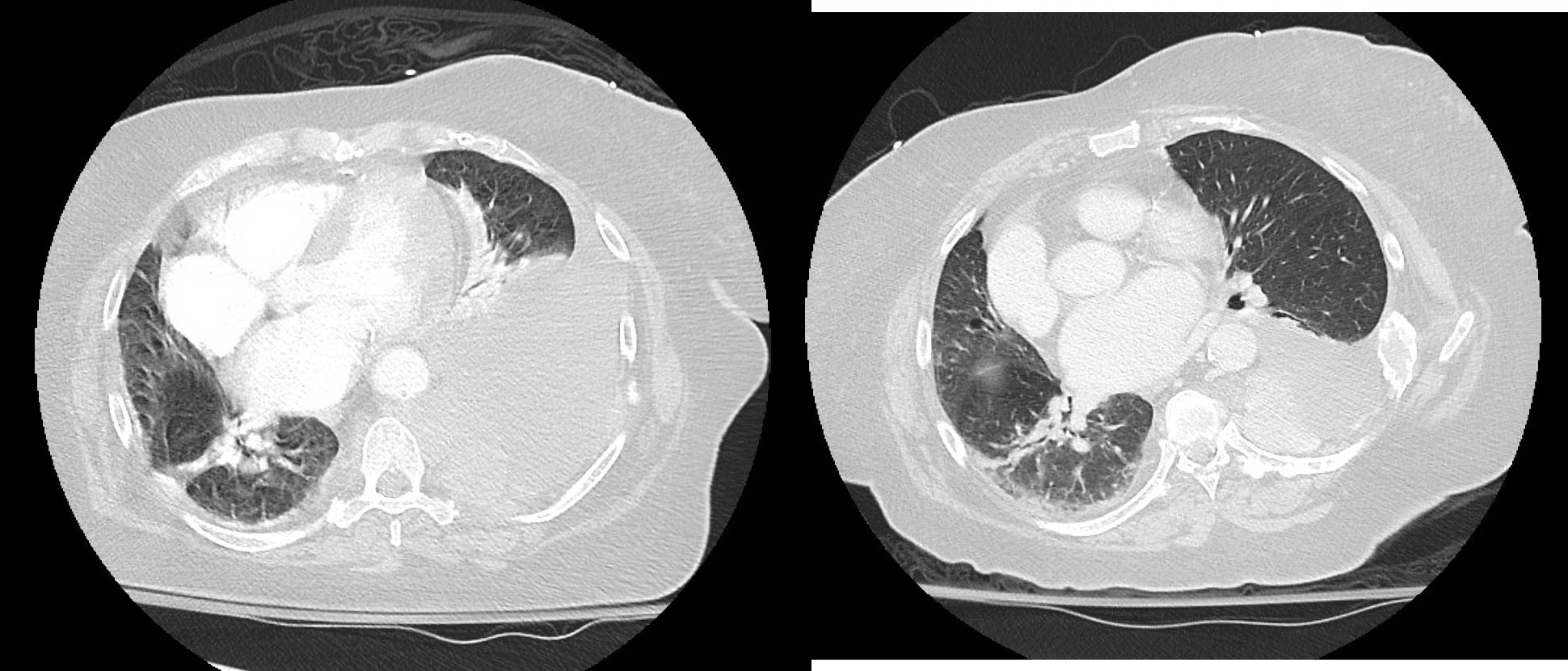
Case Presentation: 83 year old woman with known lambda light chain multiple myeloma with recent recurrence 2 years ago, presented to the ED with subacute onset of dyspnea and fatigue over last 2 weeks. She was found to have a large pleural effusion with subpleural masses on CT. She underwent immediate thoracentesis with removal of exudative fluid and biopsy of subpleural mass. Initial pleural effusion fluid analysis did not show evidence of infection but suggested malignant etiology and hence she did not require antibiotics. She was found to have plasma cells predominantly with lambda light chains on cytology and subpleural mass biopsy. Patient had a complicated course previously on multiple chemotherapy regimens. Based on poor prognosis she decided to pursue the route of hospice care after goals of care were discussed. She had shown great symptomatic improvement with initial thoracentesis and removal of 1.5 L of pleural fluid. She underwent placement of pleural catheter for purposes of palliation and was discharged under hospice care.
Discussion: Multiple myeloma is a neoplastic proliferation of plasma cells in the bone marrow. Multiple myeloma comprises roughly 17% of hematologic malignancies in US. The most common findings of multiple myeloma include multiple lytic lesions, anemia, bone pain, repetitive infections, renal insufficiency, hypercalcemia, fatigue and weight loss. Plasmacytoma is the term used for a discrete, contained mass of neoplastic plasma cells in bone/axial skeleton (intramedullary) or less commonly in soft tissue/other organs such as lung, brain etc (extramedullary). It is caused by plasma cell dyscrasia. Pleural effusion is an unusual complication of multiple myeloma, seen in as few as 6% of multiple myeloma patients, and mostly signifies a concurrent condition such as secondary malignancy or amyloidosis. Malignant myelomatous pleural effusions, as reported in this patient, is extremely rare accounting for less than 1% of patients of multiple myeloma. This case report describes a multiple myeloma patient with an extramedullary plasmacytoma of the pleural cavity leading to pleural effusion. Extramedullary plasmacytomas constitute a very small percentage of plasma cell tumors and majority of these primarily arise in the region of the head and neck. The patient under discussion is a known case of untreated multiple myeloma and presented with a pleural effusion secondary to a pleural plasmacytoma.
Diagnosis requires either cytology confirming neoplastic plasma cells in the pleural fluid, as in our patient, or a positive electrophoresis of the fluid. Rising IgA paraprotein levels have been reported to have some association with myelomatous pleural effusions.
Conclusions: This case highlights the challenges faced in evaluating a case of pleural plasmacytoma. Because the incidence of myelomatous pleural effusions in multiple myeloma is rare, the tumor is often overlooked in lieu of more common diagnoses. Plasmacytomas in multiple myeloma patients signify poor prognosis. Goals of care should be addressed; risks and benefits of chemotherapy discussed. Pleural catheter placement for palliation should be considered in patients who are not candidates for chemotherapy due to aggressive progression of pleural effusions.