Background: Procedural consent conversations are challenging for patients with limited English proficiency (LEP) and/or low health literacy. Pictogram-based visual guides can enhance clinician communication and patient comprehension.
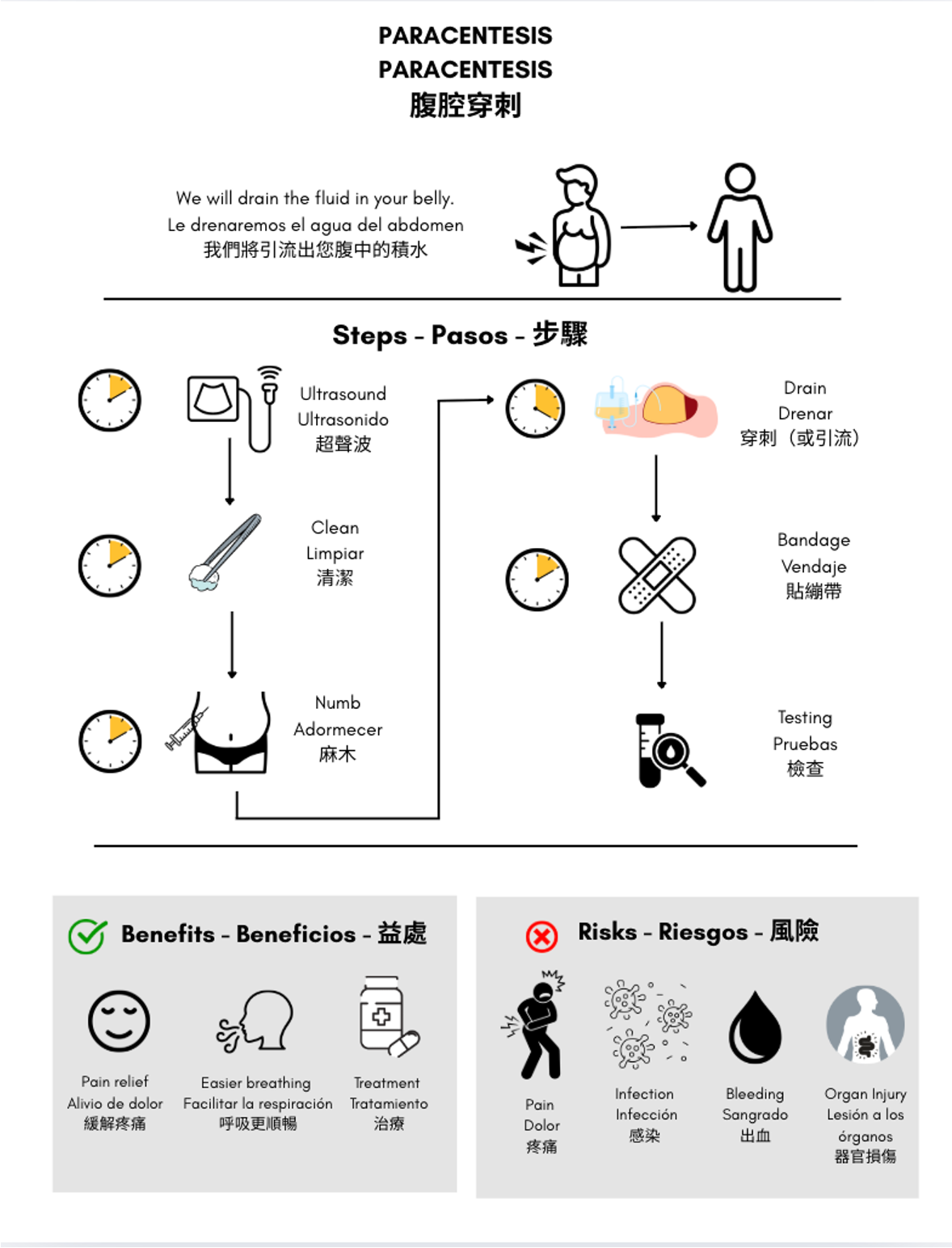
Purpose: We developed a literacy- and language-inclusive easy-read visual guide to improve informed consent processes for paracentesis procedures at a large hospital center (figure 1).
Description: We created a one-page infographic with simple images and accessible English text accompanied with Spanish and Chinese translations. The infographic was created by a medical student with close guidance of physicians on the procedural team. Feedback on the helpfulness of the guide was obtained through surveys administered over email and in person from various stakeholders including procedural physicians and the Patient and Family Advisory Committee (PFAC). Once feedback was incorporated, the tool was piloted on the hospital floor to receive feedback from patients and family caregivers who were undergoing a paracentesis. Once the infographic endured several rounds of edits, we worked closely with the translations team to translate captions into Spanish and Chinese, paying special attention to preserve the meaning of each caption. Translators had extensive experience in working in hospital medicine inpatient floors and had a good understanding of what a paracentesis is. Procedural physicians (n=6): 100% said the visual aid guide helped explain the procedure and supported the creation of similar information sheets. One clinician said the graphic “could potentially help reassure patients who are more anxious around procedures.”PFAC (n=5): 80% had never heard of paracentesis; all found the sheet somewhat helpful for understanding.Patients (n=10): 9 had prior paracenteses; 8 were patients with LEP. All felt the visual aid guide improved comprehension and consent discussions.Feedback from clinicians, patients, and families showed strong support for the visual aid guide’s clinical utility.
Conclusions: Simple, multilingual visuals aids are supported by physicians and patients alike. Using simple, multilingual visuals can enhance patient understanding and support shared decision-making in bedside procedures such as paracentesis, contributing to more equitable healthcare communication. Stakeholders had comprehensive feedback that we hope to incorporate in future iterations.Examples of feedback from stakeholders that we hope to incorporate in future iterations – Patients: Include a comprehensive Q&A on aftercare. PFAC: Adjust paracentesis graphic to represent an abdomen more clearly and have a clock representing cumulative time. Physicians: Simplify wording as much as possible to increase accessibility and add additional languages.Our pilot experience suggests that a concise, pictogram-based guide can support clearer provider–patient dialogue and help patients feel more informed during procedural consent. As next steps, we aim to collaborate with the hospital graphics team for formal branding, and to make the infographic available online for clinical use. We hope to create similar guides for other common bedside procedures.