
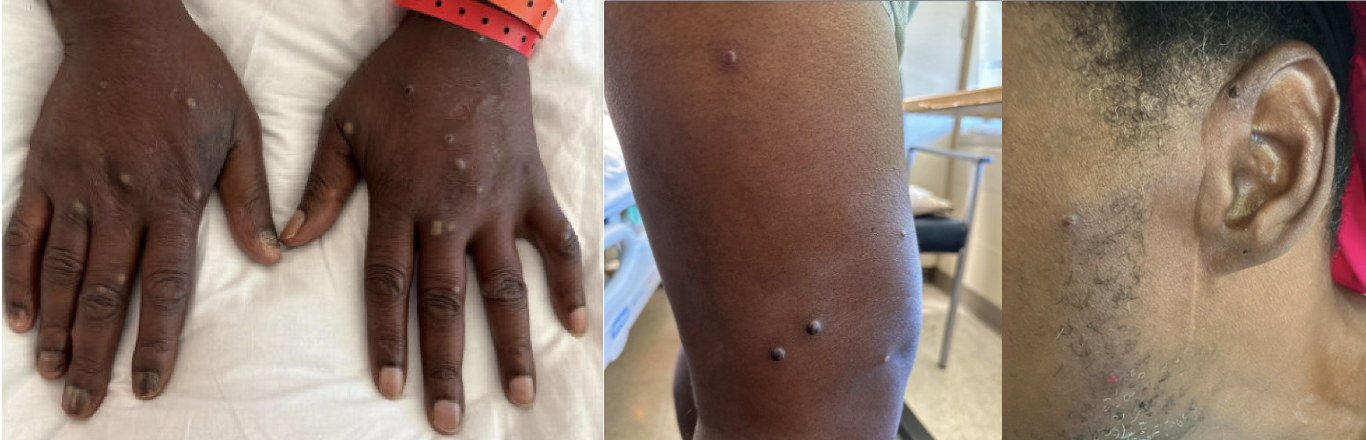
Case Presentation: A 53-year-old unhoused, transgender woman with intermittently treated advanced HIV (CD4 157 cells/µL), chronic HBV, depression, polysubstance use disorder, and recent initiation of gender-affirming estrogen presented to the ED with chest pain and suicidal ideation. CT angiography revealed bilateral pulmonary emboli (PE) with right-heart strain for which she was treated with heparin and subsequently transitioned to apixaban.One week into hospitalization, she developed painful vesiculopustular lesions on the bilateral palms, face, thighs, perianal region, and oral mucosa (Fig. 1). Early testing for HSV, VZV, gonorrhea/chlamydia, and syphilis was negative. Given the lesion distribution and her recent unprotected sexual activity, monkeypox (Mpox) PCR testing was obtained which returned positive for Orthopoxvirus (Clade II); this was later confirmed on biopsy.She was started on treatment with tecovirimat and placed on airborne isolation. During treatment, her perianal lesions that had initially mimicked Mpox progressed into ulcerative disease (Fig. 2). Repeat PCR subsequently confirmed HSV-2 coinfection, prompting initiation of valacyclovir. After near-complete lesion healing, she opted for a self-directed discharge with outpatient follow-up with psychiatry, social work, and substance use navigation services.
Discussion: Mpox is a zoonotic viral infection characterized by fever, myalgias, and a papular rash that evolves into vesicles, pustules, and crusts in the anogenital and oral regions. [1] Most Mpox infections are self-limited, but immunocompromised status and a history of prior STIs increase the risk of severe disease and co-infections. [2-4]The patient’s impaired T-cell–mediated immunity predisposed her to both reactivation of latent viruses and acquisition of new pathogens, allowing both Mpox and HSV-2 to manifest with overlapping early morphology; this initial similarity obscured the distinction between the two infections until their features diverged over time. Her concurrent PE also reflects the prothrombotic state associated with advanced HIV and systemic inflammation, with likely additional contribution from estrogen use. This case reflects not only medical complexity but also how structural and social factors contribute to negative outcomes in vulnerable populations, such as in our patient with housing instability, HIV, and gender dysphoria.
Conclusions: Viral dermatologic manifestations in immunocompromised patients can appear atypical, overlapping, and diagnostically confounding. Persistent or polymorphic lesions should prompt consideration of coexisting infections, early diagnostic testing, and repeat testing when initial studies are negative. This case emphasizes the importance of multidisciplinary coordination between infectious disease, social work, and public health, with attention to social determinants of health to support patients experiencing intersecting sociomedical vulnerabilities.
.png)