Background: Written discharge instructions improve patient understanding and self-management after hospitalization, and they are an evidence-based practice to improve patient understanding. However, over the past three decades, studies have shown that patients have poor understanding and routinely overestimate their understanding of provider recommendations, placing them at higher risk for adverse medication events and hospital readmissions. This misalignment is even higher in patients with non-English language preference (NELP) who experience higher readmission rates for diagnoses that require intensive self-management (e.g. congestive heart failure) and are more likely to report post-discharge problems, including confusion about their discharge instructions. Our primary goal was to evaluate the quality of discharge instructions by considering the content quality and language used. Our second goal was to compare the quality of discharge instruction between patients with English and NELP patients and between low and high intensity of self-management instructions.
Methods: We analyzed 200 discharge records from inpatient medicine discharges at one hospital across a range of 10 general diagnoses using case matching to construct English and NELP cohort (each n=100). The diagnoses were divided into diagnoses that require low or high-intensity self-management (each n=100). We assessed the percentage of discharge instructions written in the patient’s preferred language. Two individual raters used a scale—the Quality of Discharge Instructions (QDI) scale—to rate discharge summaries across six domains of content quality. The relationships between QDI and language, and QDI and the intensity of self-management, were examined.
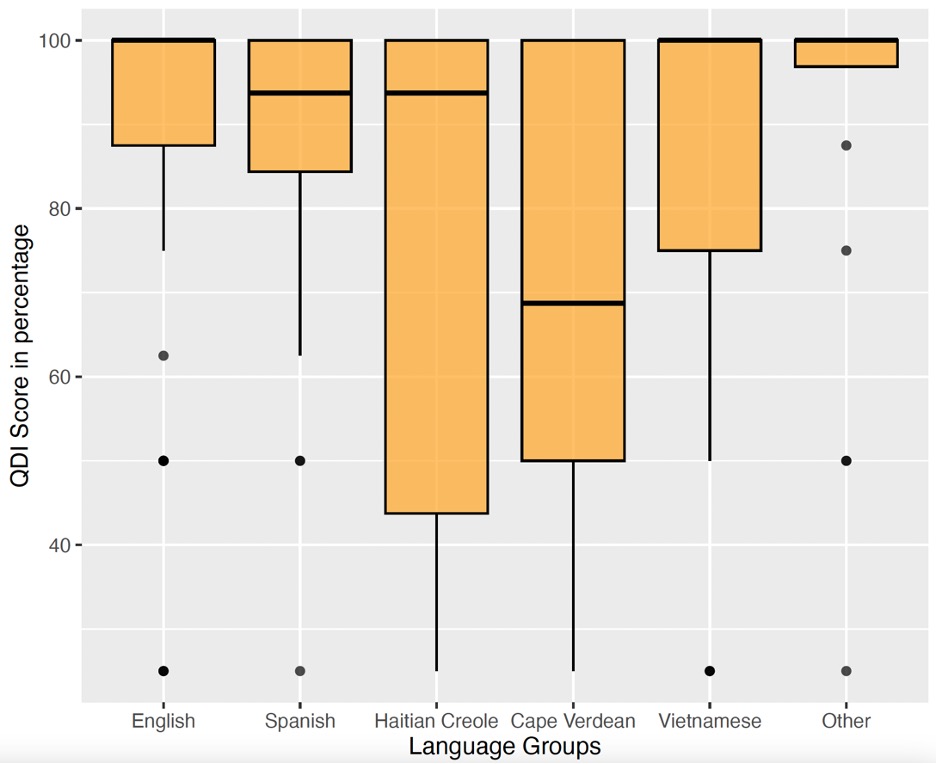
Results: Only 8% of patients with NELP received discharge instructions that were language concordant compared to 100% in the English cohort (p< 0.001). The mean overall QDI score was similar for the NELP and English cohorts (17.06 versus 17.10 out of 24, p=0.092), but the domain of return precautions was inferior among those with NELP (3.22 vs 3.55, p=0.013). The difference in the overall mean QDI score between low and high-intensity self-management diagnosis was statistically significant (16.65 versus 17.51 out of 24, p = 0.04).
Conclusions: We found disparities in the quality of written discharge instructions for patients with NELP. Diagnoses with a higher complexity of self-managements had a higher quality of discharge instructions. Recommended next steps include replication of our methods across multiple health systems and larger sample sizes to examine differences between non-English language groups and self-management groups.