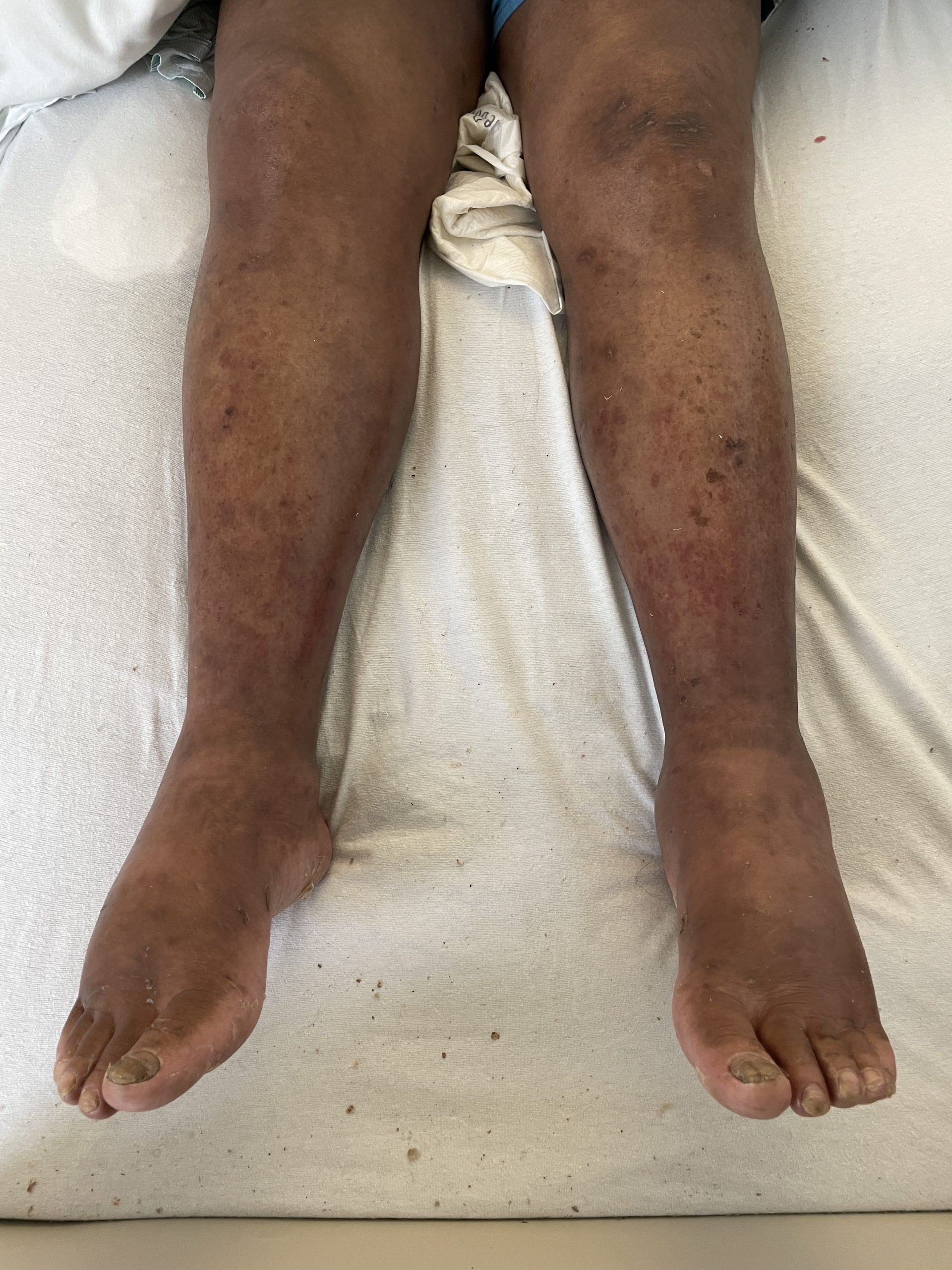
Case Presentation: A 46-year-old male with PMHx of alcohol use disorder and a partial gastrectomy (Roux-en-Y, vagotomy, paraoesophageal hernia repair) over 10 years prior who presented with a rash extending bilaterally from the elbows to extremities and trunk with the presence of bullae and skin sloughing. Labs were notable for hemoglobin of 6.8 g/dL, thrombocytopenia, hypernatremia, and non-anion gap metabolic acidosis with hyperchloremia. He received 1 unit of packed RBCs. Dermatology was consulted and performed a punch biopsy that showed “broad and diffuse parakeratosis overlying an epidermis demonstrating superficial pallor accompanied by some vacuolated cells and focal mild spongiosis as well as sparse to mild superficial perivascular lymphocytic infiltrate with scattered red blood cell extravasation”. Findings were concerning for either nutritional deficiencies such as zinc, niacin, and biotin or necrolytic migratory erythema. Further workup revealed low zinc at 35 mcg/dL, low vitamin E at 2.5 mg/L, and low vitamin A at 5.7 mcg/dL. Of note, the patient revealed daily copper supplementation intake. He was diagnosed with necrolytic migratory erythema and was started on oral zinc, copper, and multivitamins for his nutritional deficiencies while given zinc oxide ointment and petrolatum for his rash. His clinical condition started to improve, and he was discharged home with copper gluconate and zinc sulfate.
Discussion: Necrolytic migratory erythema (NME) is a condition of the skin that often presents with psoriasiform or eczematous, violaceous, and erythematous plaques at peripheral flexures, face, extremities, and perineum that spread diffusely. These lesions start as small plaques or papules that slough leaving crusty and scaly borders that progress to bronze annular lesions. While the underlying pathophysiology is unknown, it is thought to be multifactorial. NME is commonly associated with pancreatic glucagonoma; however, it has been seen in patients with hepatic cirrhosis, celiac disease, cystic fibrosis, and nutritional deficiencies. Normal zinc function is important for regulating keratinocyte apoptosis. In fact, zinc deficiency is one potential causes of NME leading to skin sloughing. This condition can be considered a type of deficiency dermatosis. It is often seen in patients with nutritional deficiencies such as vitamin B12, folic acid, iron, calcium, vitamin D, and copper with few seen cases after Roux-en-Y. Differential diagnoses include pellagra, acrodermatitis enteropathica, and pemphigus foliaceous to name a few. Our patient underwent a Roux-en-Y over 10 years prior that resulted in multiple nutritional deficiencies that were inadequately monitored. He subsequently developed a zinc deficiency that was exacerbated by his daily copper supplementation. Copper is known to competitively interact with zinc absorption in the small intestine, worsening the zinc deficiency and contributing to the necrolytic migratory erythema presentation.
Conclusions: Necrolytic migratory erythema is a rare skin condition that should be considered in patients with a history of Roux-en-Y bypass due to the increased risk of nutritional deficiencies. Daily copper intake can worsen zinc deficiency if adequate zinc supplementation is not provided. Patients with Roux-en-Y bypass must be followed regularly, adequately monitored and treated for nutritional deficiencies and other long-term sequela.