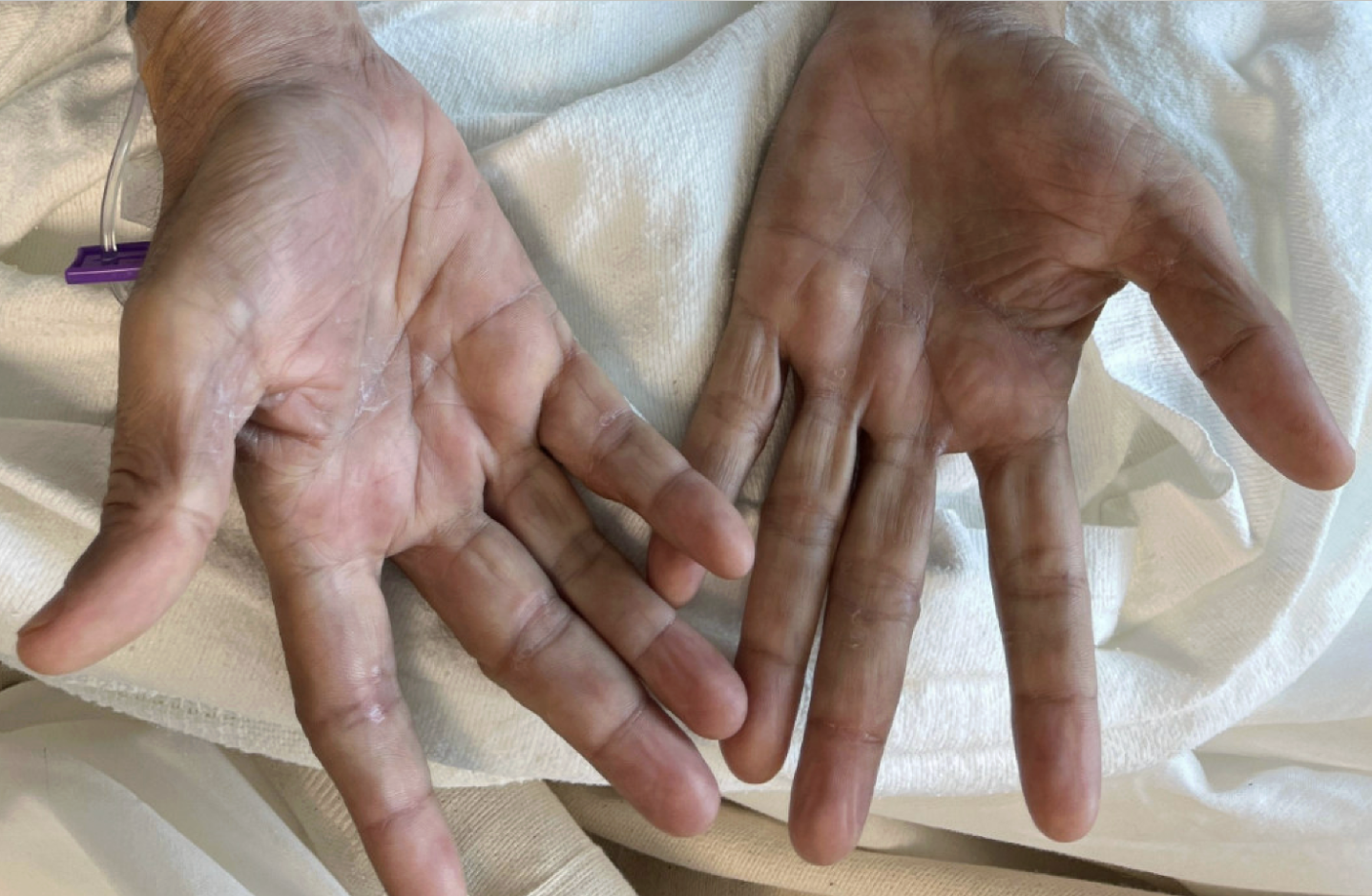
Case Presentation: 49 year-old male with no past medical history presented with chief complaint of abdominal discomfort and rash. Symptoms began after discharge from an outside hospital where he was diagnosed with hepatitis and pancreatitis as well as needing a cholecystectomy. The abdominal discomfort was generalized and did not change with meals. He denied any nausea/vomiting and was tolerating a regular diet. His rash was non-painful non-pruritic and diffusely distributed.On presentation patient was afebrile with normal vitals. Exam was notable for mild tenderness on deep palpation to right upper quadrant with negative Murphy’s sign as well as diffuse maculo-papular rash including the palms and soles.Labs were notable for a cholestatic liver injury with thrombocytosis, normal INR and mildly elevated lipase. CT abdomen/pelvis showed acute interstitial edematous pancreatitis with gallbladder sludge and stones. RPR was positive with subsequent titer initially pending. Hepatology was consulted however deferred as suspected gallbladder pancreatitis and recommended GI and general surgery consults. GI consulted and recommended autoimmune pancreatitis/hepatitis workup and consult to general surgery for cholecystectomy. MRCP was also completed showing findings consistent with interstitial pancreatitis and further discussion with radiologist suspected an infiltrative process such as autoimmune as opposed to gallstone pancreatitis. Given the high index of suspicion for secondary syphilis, general surgery consult was not pursued as unclear if patient had true gallbladder pancreatitis. Ultimately Treponema antibodies returned positive with RPR quantitive 1:256. Given lack of neurologic symptoms patient met criteria for secondary syphilis with syphilis hepatitis and was given IM penicillin with significant improvement in liver enzymes prior to discharge and complete resolution of abnormal liver enzymes one month later.
Discussion: This case presented a diagnostic challenge as patient presented with abdominal pain, cholestatic liver injury, cholelithiasis and pancreatitis: the classic illness script for gallstone pancreatitis. However when added in rash and an atypical presentation of pancreatitis the differential changes. Few case reports have documented syphilis hepatitis or pancreatitis demonstrating its rare manifestation. Without a high index of suspicion appropriate therapy could have been delayed and patient could have undergone an unnecessary cholecystectomy as patient was repeatedly labeled as gallstone pancreatitis. The rapid resolution of symptoms and normalization of liver enzymes after IM penicillin further proves the diagnosis of syphilis hepatitis. Syphilis pancreatitis remains a questionable diagnosis as there were no diagnostic tests to confirm this suspicion.
Conclusions: As a hospitalist it is key to consider every aspect of a patient’s presentation. Although patients can present with multiple problems, Occam’s razor can prevail with the appropriate diagnostic pause and clinical suspicion. Instead of syphilis and gallstone pancreatitis this patient had secondary syphilis with multiorgan involvement. Given the increased rate of syphilis over last decade, unexplained cholestatic liver injury should prompt syphilis testing. Further investigation is needed to determine if syphilis pancreatitis is a true diagnostic entity. Syphilis is often called The Great Imitator because it can affect any organ so perhaps this is a case of syphilis pancreatitis.
.png)