Background: Introducing medical residency programs into community hospitals can raise concerns about potential negative effects on care quality and patient satisfaction. Patient experience is a core quality metric linked to clinical outcomes, yet evidence is limited on how launching a new residency affects patient experience in previously non-teaching settings. Our objective is to evaluate the impact of starting a new Internal Medicine residency program at a community hospital on patient experience scores, using the remainder of a regional hospital division as a comparison.
Methods: We conducted a retrospective quasi-experimental study in a Gulf Coast hospital division. The intervention was the launch of a residency program in July 2024 (Q3 2024) at one hospital (“Clear Lake”), with other division hospitals as controls. We analyzed inpatient satisfaction surveys (top-box % of physician-related questions) over 8 quarters (4 pre, 4 post). We used two-proportion z-tests to compare pre/post scores, interrupted time series (ITS) to assess trend changes, and difference-in-differences (DiD) regression to compare Clear Lake’s changes with peers. Provider-level paired analyses evaluated within-provider score changes.
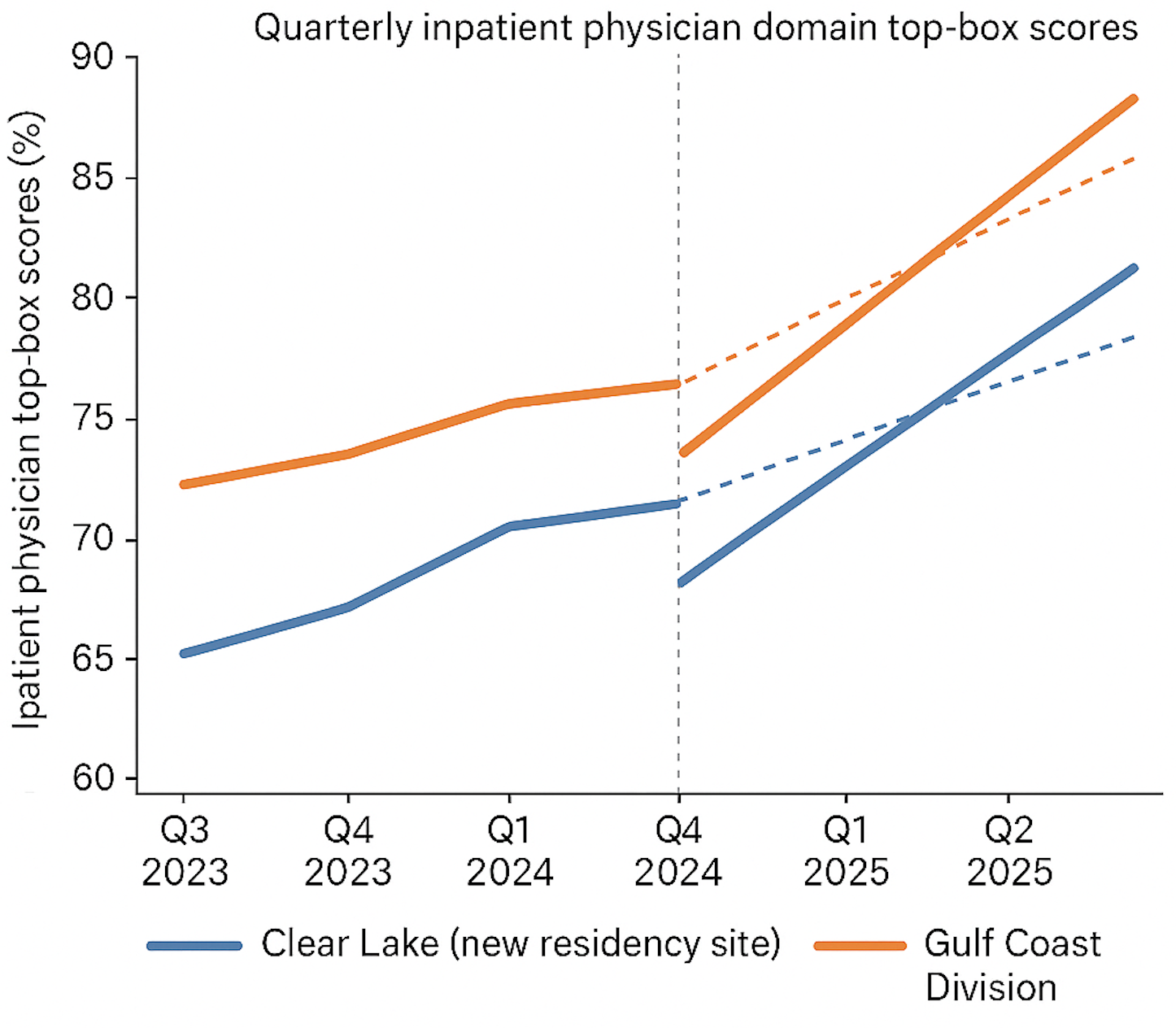
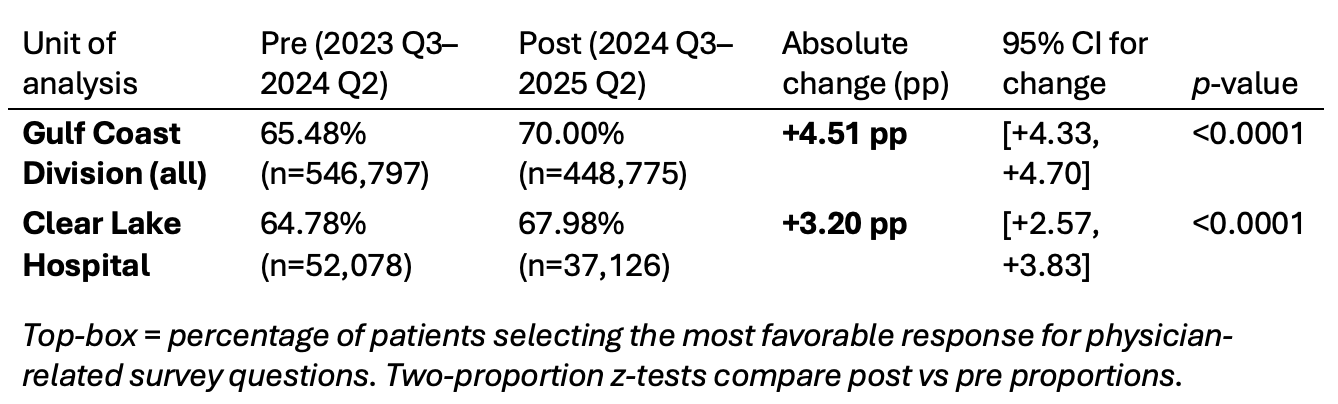
Results: We included >1,000,000 survey responses (~547,000 pre, 475,000 post) from 15 hospitals. Division-wide top-box provider experience scores rose from 65.5% to 70.0% (Δ+4.5 pp; p< 0.0001). Clear Lake improved from 64.8% to 68.0% (Δ+3.2 pp; p< 0.0001). ITS modeling showed significant acceleration in improvement post-intervention (slope +3.74 pp/quarter, p=0.026 division-wide; +3.72 pp, p=0.067 Clear Lake). No level drop occurred at program start. DiD analysis found Clear Lake’s gain was slightly smaller than peers’ (−1.04 pp; p< 0.001). Fourteen of 15 hospitals improved; Clear Lake’s improvement was below the median. Provider-level mean scores rose +5.17 pp division-wide (p< 0.0001), +3.07 pp at Clear Lake (not significant). Communication domains improved modestly.
Conclusions: Launching a residency program was associated with improved patient experience trends, not deterioration. The teaching hospital improved in parallel with peers, suggesting residents can be integrated without compromising patient satisfaction.