Background: Hospital medicine is among the fastest growing specialties in academic medicine (1), with concerns remaining about how best to balance clinical care demands with academic contributions (2, 3). Hospitalist professional organizations have responded by calling for stronger nationwide mentorship and training programs to develop a more sustainable field (3). A 2023 scoping review appealed for institutional faculty development programs with dedicated leadership, financial support for academic time, and tailored mentorship to support faculty (4). Additionally, nurturing niche expertise promoted engagement and advancement (4,5). However, the lived experiences within hospitalist professional development are still poorly understood. With this in mind, we explored the processes by which hospitalist faculty experience said professional development, including the factors that facilitate and impede growth, to inform program design efforts aimed at promoting hospitalist career advancement.
Methods: A purposive sample of 11 hospitalist faculty members, differing by age, gender, faculty rank, and years in rank, were identified to participate in an hour-long structured interview to assess factors that influence career development. Qualitative data were subsequently analyzed via an interpretive phenomenological approach (6, 7). Emergent themes were identified via reflexive writing sessions and iterative re-review. Summary findings were shared with participants as a validation step.
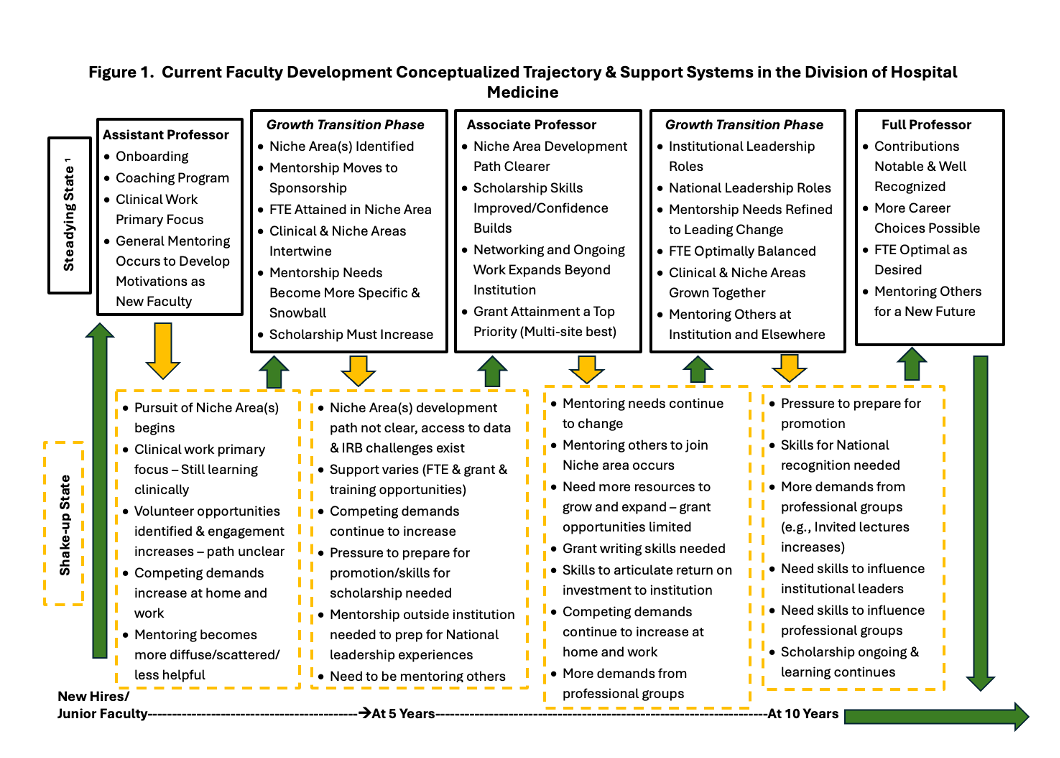
Results: Of the faculty members interviewed, three broad niche areas were identified: Quality Improvement and Patient Safety, Medical Education, and Health Systems Administration. Niche development itself followed one of four distinct pathways: 1) beginning before or during residency with easy transition as faculty, 2) early faculty identifying niches via trial and error or mentorship, 3) “falling into” a niche area later in time with guidance, and 4) still lacking a defined niche area due to incongruence with personal or clinical obligations. Facilitators of academic growth were similar across niches: 1) starting early; 2) prior training or program access; 3) being a self-initiator; 4) mentoring and/or networking; and 5) having a mentorship relationship that included sponsorship. Common inhibitors included lack of time, unclear pathway for advancement, lack of knowledge of promotion process, struggles with producing scholarly work, a lack of grant writing skills, and in general a prolonged difficulty in navigating their way past the aforementioned roadblocks. A recurrent theme of oscillation between so-called “steadying” and “shake-up” states, where the path to the next career milestone (promotion, protected time, leadership, etc.) required overcoming uncertainty or acquiring new skills to reach the next steadying state (Figure 1).
Conclusions: Our study uncovers that hospitalist professional development is multifaceted and enormously influenced by both niche development and engaged mentorship. Our work underscores a clear need to create structured supports outside the usual medical education pathways that help new and experienced faculty alike navigate common “shake-ups” that stall advancement.