Background: The pediatric hospital medicine (PHM) workforce has experienced change and growth over the past few decades. On July 1, 2025, the Accreditation Council for Graduate Medical Education (ACGME) implemented changes to pediatric residency programs, allowing for greater individualization of resident experiences. These ACGME changes have led some institutions to rely on pediatric hospitalists to provide increased coverage of hospitalized patients. The purpose of our qualitative study was to understand the perceptions of PHM group leaders regarding the ACGME residency changes on 1. The PHM workforce, 2. hospitalist career satisfaction, 3. future opportunities for the PHM workforce.
Methods: To understand the anticipated impact of the ACGME pediatric residency changes, we invited PHM leaders to participate in focus groups prior to implementing the 2025 ACGME changes at their respective institutions. Focus groups were facilitated using a semi-structured interview guide derived from prior research and the study team’s expertise.Using a rapid qualitative approach, we developed templated summaries and a matrix analysis. The study team summarized focus group content directly from recordings, supplemented with transcriptions and field notes. Each focus group was summarized by 2 or more team members; the summaries were then used to develop the matrix. Team members followed a structured mixed deductive and inductive approach to analyze the matrix. Focus group themes and sub-themes were discussed until the study team reached consensus.
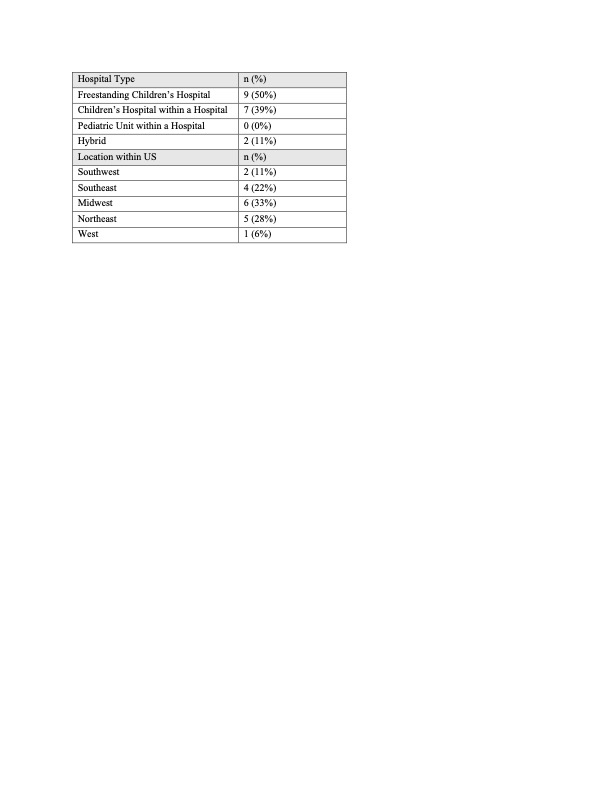
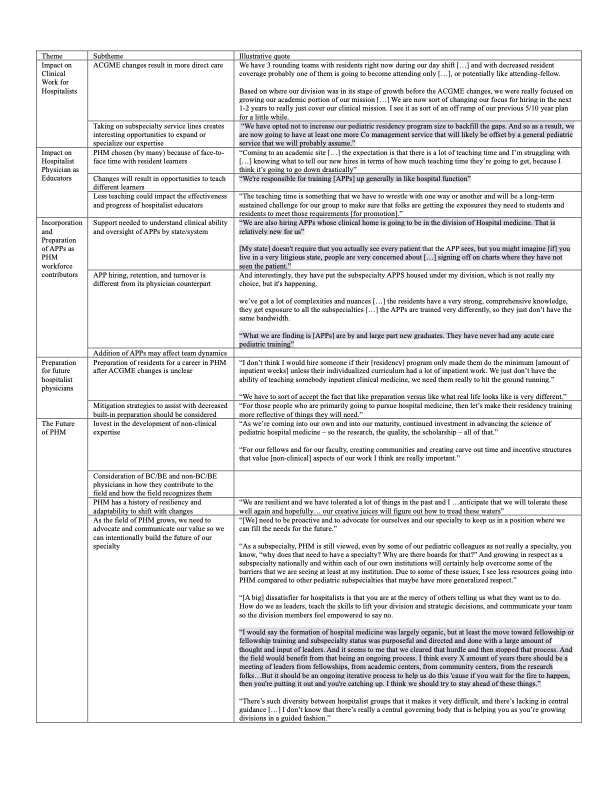
Results: There were 7 focus groups with a combined total of 18 participants. Table 1 summarizes the focus group demographics. 5 subthemes and 12 subthemes were identified. Themes included: impact on clinical work for hospitalists, impact on hospitalist physicians as educators, incorporation and preparation of advanced practice providers as PHM workforce contributors, preparation of future hospitalist physicians, and the future of PHM. Table 2 shares our study’s themes, subthemes, and illustrative quotes.Hospital systems rely heavily on the PHM workforce’s adaptability as clinical, educational, and operational leaders, demonstrating the PHM subspeciality’s value and wide skillset. This qualitative study highlights how the ACGME pediatric residency changes, directly and indirectly, were anticipated to impact the PHM workforce. As a result of the ACGME residency changes, PHM groups must develop and enact plans to hire and prepare the future workforce of physicians and APP team members. PHM’s future will require leaders to collaborate and advocate, locally and nationally, to intentionally and proactively guide the growth of the subspecialty.
Conclusions: PHM leaders believed there were multiple ways that the 2025 ACGME residency changes would or may impact the PHM workforce in the future. Themes identified in this study can help guide and focus PHM leaders’ efforts to build its workforce in areas that are expected to be most impacted by the ACGME changes.